When the Server Holds Forty People, What Does 'Massively Multiplayer' Still Mean?
Examines how sharding, instancing and megaserver architecture — decisions documented in developer postmortems and GDC talks — have eroded the 'massively' in MMO until the technical definition no longer matches the genre label. An analytical piece about infrastructure as genre definition.
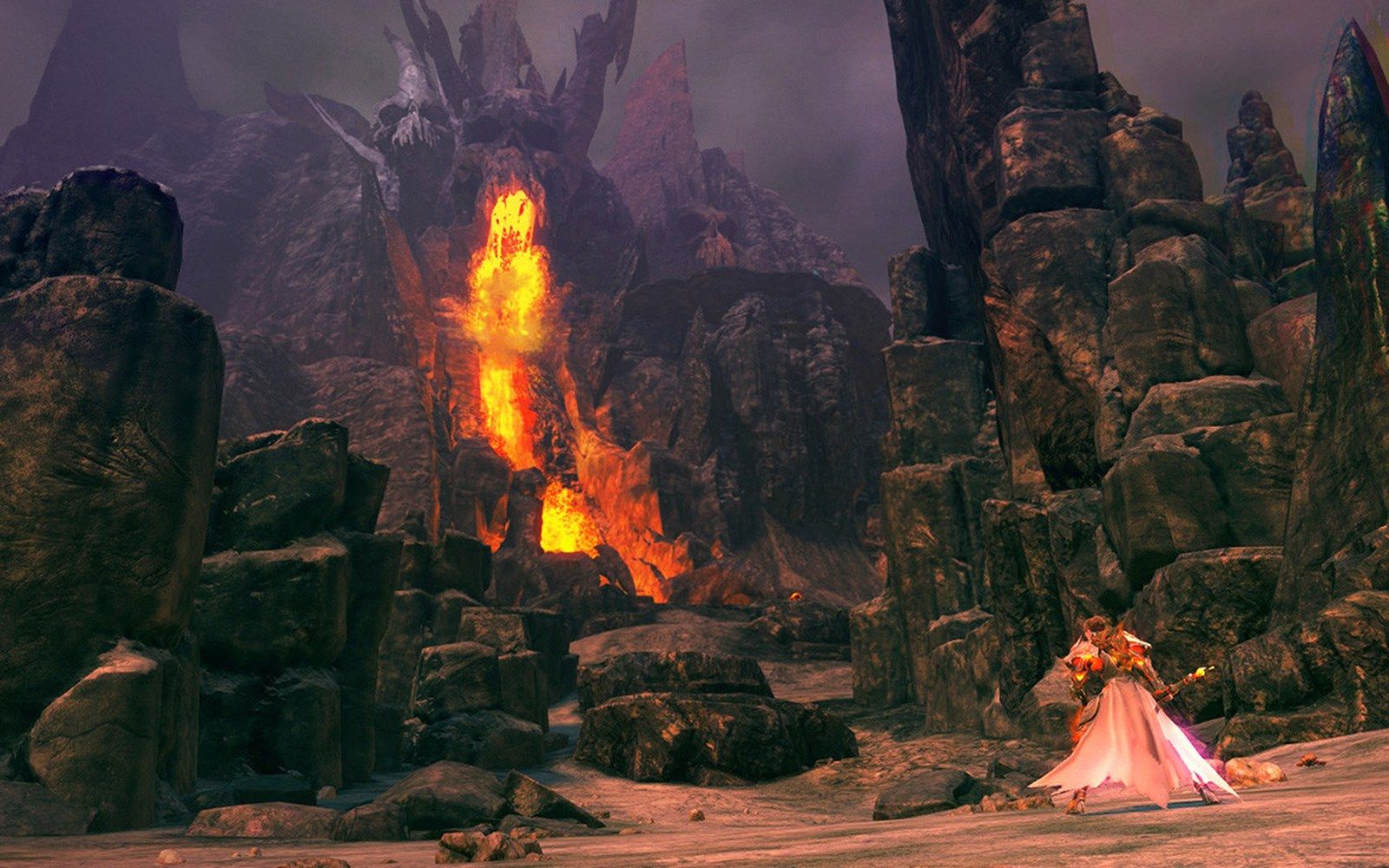
When a shard holds forty people, the first M in the acronym is doing no work.
Photo: Guild Wars 2® / Steam
Sharding, instancing, and the megaserver quietly retired the genre's founding premise. The label stayed.

The storefront most of the genre’s revenue now passes through, on the platform its largest earners were built for.
Photo: RDNE Stock project / Pexels
The Architecture Drained the Word First
Richard Bartle, who co-created MUD1 at the University of Essex in 1978, defined the genre's original promise in blunt terms: a single, persistent world where every action ripples across a shared population. The massively in MMO was not a descriptor for player count alone — it was a structural claim. Everyone occupied the same space. What another player did, you felt.
Infrastructure timeline
- 1997Ultima Online ships named "shards"; server splits are full-instance separation at login
- 2004World of Warcraft launches with per-realm caps; multiple parallel "Azeroths" coexist
- 2013ArenaNet implements megaserver for Guild Wars 2, dynamic instancing behind unified world name
- 2015The Elder Scrolls Online adopts megaserver architecture for console launch
That claim began dissolving the moment developers confronted the mathematics of real load. Early Ultima Online shards — named, pointedly, after the fractured world of Ultima lore — were full-server splits rather than elegant architecture. When World of Warcraft shipped in 2004, it imposed server-level caps that meant the phrase "Azeroth" described dozens of parallel, non-communicating worlds. Even then, the shared illusion held within each server. Players could, and did, encounter thousands of contemporaries within a single realm, and the population was visible in every city, every contested zone.
Sharding changed the logic qualitatively. Rather than partitioning players by server at login, sharding divides a single named server's population into multiple simultaneous, largely invisible instances at runtime. A player in Stormwind in 2023 may share their instance with a few dozen people; the system routes them to whichever shard has room, without their knowledge or consent. The zone appears populated enough. It is not a world — it is a waiting room that looks like one.

Photo: NCSOFT logo · Wikimedia Commons
Megaservers Unified the Namespace, Not the Population
The megaserver model, used by The Elder Scrolls Online since its 2014 launch and by Final Fantasy XIV's data-centre travel system in a different form, was marketed as the opposite of fragmentation. No dead server lists; no realm-transfer fees; one version of the world. Technically, that is accurate. Socially, it compounds the problem: a megaserver dynamically assigns players to instances behind a single world name, so the population figure behind that name is meaningless as a gauge of co-presence.
Guild Wars 2, which ArenaNet retrofitted with a megaserver after launch, published a developer blog post explaining the system's population-balancing logic — optimising for players seeing other players, not for players seeing the same players. The distinction sounds technical. It is actually the genre-level distinction. Community, economy, consequence — the properties that the academic literature on virtual worlds consistently identifies as core MMO traits — all depend on repeated exposure to an identifiable population, not to a rotating cast of strangers.
The Label as Legacy, Not Description
The question is not whether modern infrastructure is better engineering. It is. Sharding and instancing allow live-service games to absorb launch-day population spikes that would have destroyed a 2004-era server, and megaservers eliminated the dead-realm problem that silently killed mid-tier MMOs by stranding small populations in empty worlds. The tradeoff is real and defensible.
The question is whether "MMO" still describes what the infrastructure produces. When a zone instance caps at forty or eighty concurrent players — figures cited repeatedly in community postmortems for games including Guild Wars 2 and New World, though Amazon Games has not published official instance-size documentation — the massively has become a legal fiction. The game is a very-well-populated instance-based online RPG. That is a different thing.
Raph Koster, whose writing on virtual world design remains widely cited across developer postmortems and GDC talks, has argued since at least 2008 that the social fabric is the feature — that without persistent, large-scale co-presence, what remains is a content-delivery mechanism with a chat box. The infrastructure decisions of the subsequent fifteen years have not refuted that argument. They have, quietly, made the case for it: the genre label now describes a lineage and a marketing category, not a technical reality. Forty people in an instance is a lobby. It takes more than a legacy acronym to make it a world.