From Essex, 1978 to Azeroth, 2004: The Twenty-Six Years That Built the Genre's Template
A compressed narrative history from MUD1 at the University of Essex through Ultima Online (1997), EverQuest (1999) and World of Warcraft (2004), naming the decisions and the people behind them that established the conventions every subsequent game inherited. One long-form historical piece.
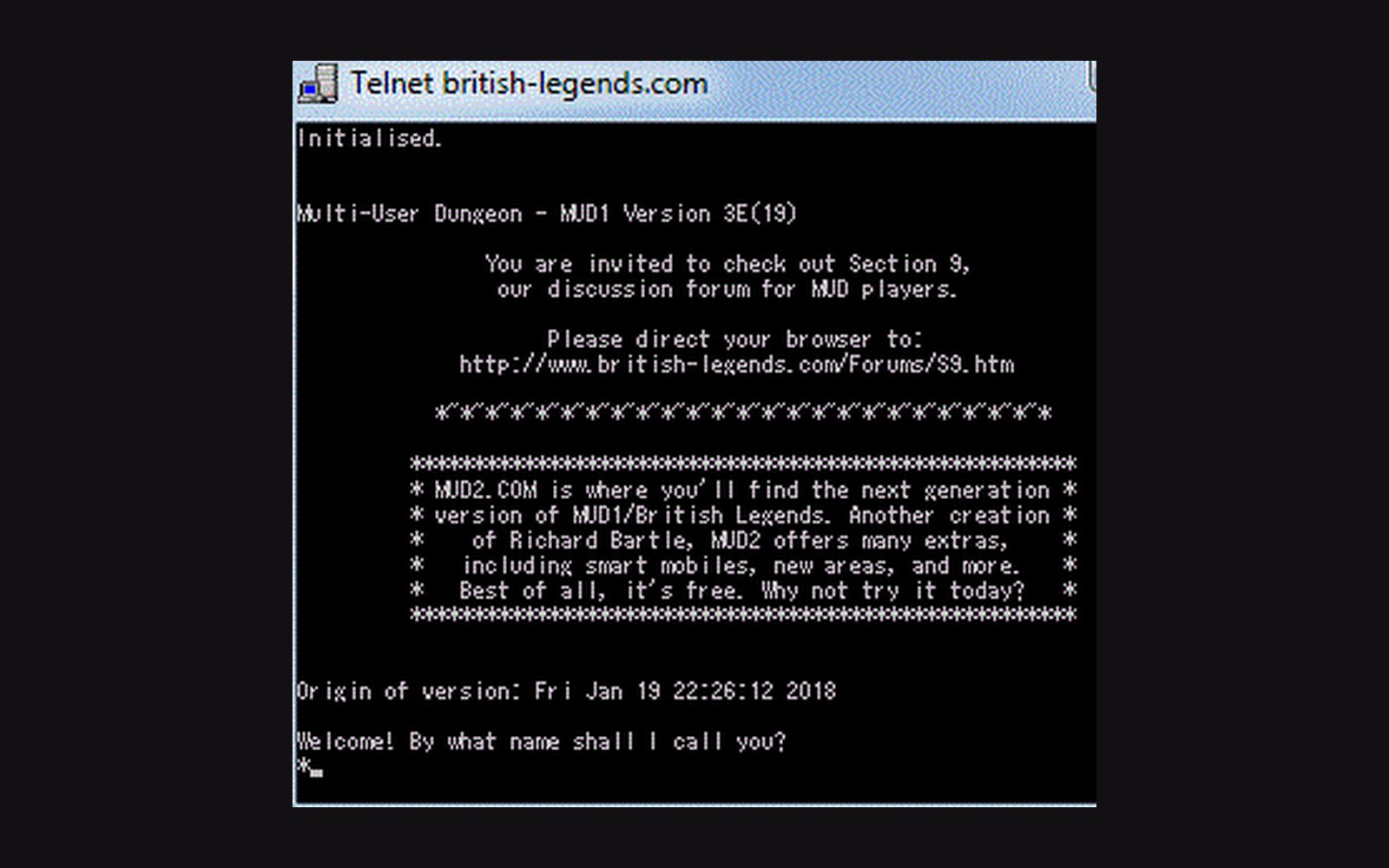
Twenty-six years from a university mainframe to twelve million subscriptions.
Photo: MUD1 · Wikimedia Commons
The mechanics, the business models and the social contracts that govern every MMO today were largely settled before most of the genre's current players were teenagers.

Photo: Roblox Logo 2022 · Wikimedia Commons
A University Machine Room and Two Students Who Wanted to Build a Shared World
In 1978, Roy Trubshaw wrote a program on a DEC PDP-10 at the University of Essex ↗ that allowed multiple users to inhabit a shared text environment simultaneously. Richard Bartle, his collaborator, expanded it into what became MUD1 — Multi-User Dungeon — and when Essex connected to ARPANET in 1980, MUD1 became accessible to players outside the university. The game was not commercially released; it ran on university infrastructure and was free at the point of use. But it established, at the foundational level, the defining proposition of the genre: many people, one persistent world, consequences that outlast a single session.
Chronology
- 1978Roy Trubshaw writes MUD1 at the University of Essex
- 1980Essex connects to ARPANET; MUD1 becomes externally accessible
- 1996Richard Bartle publishes player-type taxonomy paper
- September 1997Ultima Online launches; exceeds 100,000 subscribers within a year
- March 1999EverQuest launches (Sony Online Entertainment)
- 2000Ultima Online Renaissance adds Trammel, splitting PvP and PvE rulesets
- 2001Dark Age of Camelot launches, introducing structured realm-vs-realm PvP
- 2003Star Wars Galaxies launches with player-driven economy
- 2003EverQuest reaches 450,000 subscribers
- 23 November 2004World of Warcraft launches
- End of 2005WoW crosses five million global subscribers
- 2010WoW reaches twelve million subscribers
Bartle's subsequent theoretical work, particularly his 1996 paper categorising player motivations into achievers, explorers, socialisers and killers, shaped how designers thought about who their players were and what competing pressures a virtual world had to satisfy simultaneously. Those categories remain live reference points in studio design documents today.
The decade and a half between MUD1 and the first graphical online worlds was not idle. LPMud, TinyMUD, DikuMUD and their descendants codified what the text-based format could do — levelling systems, class archetypes, guild structures, player-versus-player rulesets — and trained a generation of players in expectations that the graphical era would then have to meet or consciously break.

The only public signal left on some of these games is a price or a count that moves; reading it means reading a screen like this one.
Photo: AlphaTradeZone / Pexels
Three Launches That Set the Commercial Template
Richard Garriott's Ultima series had already established the idea of a coherent virtual world with consistent internal rules. When Origin Systems launched Ultima Online ↗ in September 1997, it was Garriott's attempt to take that world online at commercial scale, subscription-funded at a monthly fee. Within a year it had surpassed 100,000 subscribers — a figure the industry had not previously considered achievable for an online game. The model worked: a boxed product generating retail revenue at launch, then recurring subscription income thereafter.
Ultima Online also generated the genre's first hard lessons. Its open-world full-loot player-versus-player ruleset produced an environment so hostile to new players that Origin had to build a parallel ruleset — Trammel, the protected facet added in the Renaissance expansion of 2000 — as an explicit safety valve. The decision prefigured every subsequent debate about how to balance player freedom against player retention, and the split between PvP and PvE server philosophies that MMOs have never fully resolved.
Key figures
Roy Trubshaw
In the record
MUD1 author, University of Essex, 1978
Richard Bartle
In the record
MUD1 co-creator; 1996 player-type taxonomy
Richard Garriott
In the record
Ultima series creator; Origin Systems founder
Brad McQuaid
In the record
lead designer on EverQuest
Mark Jacobs
In the record
designer of Dark Age of Camelot
Mike Morhaime
In the record
Blizzard Entertainment CEO at WoW launch
EverQuest, launched by Sony Online Entertainment in March 1999, took a more conservative position on player conflict and a more demanding one on group dependency. Its design, led by Brad McQuaid among others, required players to form parties for almost all meaningful progression, made death genuinely costly through experience loss and corpse retrieval, and built its world around geography that took real time to traverse. Those friction points were not accidents; they were what created the communities of obligation that kept players subscribed. EverQuest reached 450,000 subscribers by 2003, and its design grammar — tank, healer, damage dealer; instanced dungeons; raid tiers as endgame — became the template Blizzard Entertainment then refined and globalised.
The years between 1999 and 2004 were not commercially stable. Asheron's Call (1999), Dark Age of Camelot (2001, designed by Mark Jacobs), Star Wars Galaxies (2003) and Lineage — the NCsoft title that had dominated Korean subscriber counts since 1998 — each proposed variations on the template. Dark Age of Camelot introduced realm-versus-realm large-scale PvP as a structured endgame rather than an optional sandbox mode. Star Wars Galaxies attempted a player-driven economy and profession system of genuine complexity. None broke through in the Western market to the scale their ambitions targeted, and the studios were, by 2004, still operating in a market measured in the hundreds of thousands of subscribers rather than the millions.
Blizzard Executes, and the Numbers Change
World of Warcraft shipped on 23 November 2004, published by Blizzard Entertainment, then a subsidiary of Vivendi Games. Under the watch of Mike Morhaime as chief executive and a design team that had spent years studying what the previous games had proved and what they had failed to deliver accessibly, WoW systematically removed the genre's highest friction points. Death had no lasting penalty. Quests delivered explicit direction. Geography was traversable without a time cost that punished the casual player. Group content was available but the game did not hold solo progress hostage to it.
The World of Warcraft subscriber count ↗ crossed one million within a month of launch in Western markets alone. It reached five million globally by the end of 2005 and twelve million by 2010, numbers that remain unprecedented in subscription MMO history. The monthly fee, set at $14.99, generated revenue at a scale that changed what investors and publishers believed the genre could produce — and simultaneously set a bar for production values that made the genre significantly more expensive to enter.
What WoW normalised as design decisions, every subsequent game inherited as audience expectations: quest markers, instanced group content with tiered difficulty, talent trees as character customisation, an auction house as economic infrastructure, and endgame raiding as an activity designed to sustain subscriptions for months after the levelling content was exhausted. Studios building MMOs after 2004 were not competing with a genre convention; they were competing with a specific game that had established what the convention felt like when perfectly executed.
The twenty-six years from MUD1 to WoW's launch also established the subscription model as the genre's revenue logic before that logic was challenged. Ultima Online, EverQuest, Dark Age of Camelot and WoW all charged monthly fees as a condition of access. The economic arguments for and against that structure, the migration toward free-to-play cosmetic stores and battle passes, and the data on which model survives — those are a later chapter. The template settled in 2004 was the one all those later arguments were departing from.