Legal Currency Bridges: What the WoW Token and FFXIV's Chronoscroll Actually Do
Explains how the WoW Token and FFXIV's Mog Station Chronoscroll function as sanctioned real-money-to-in-game-currency mechanisms, covering their documented mechanics and the regulatory and terms-of-service context they sit inside. An explainer focused on the economic structure, not gameplay.
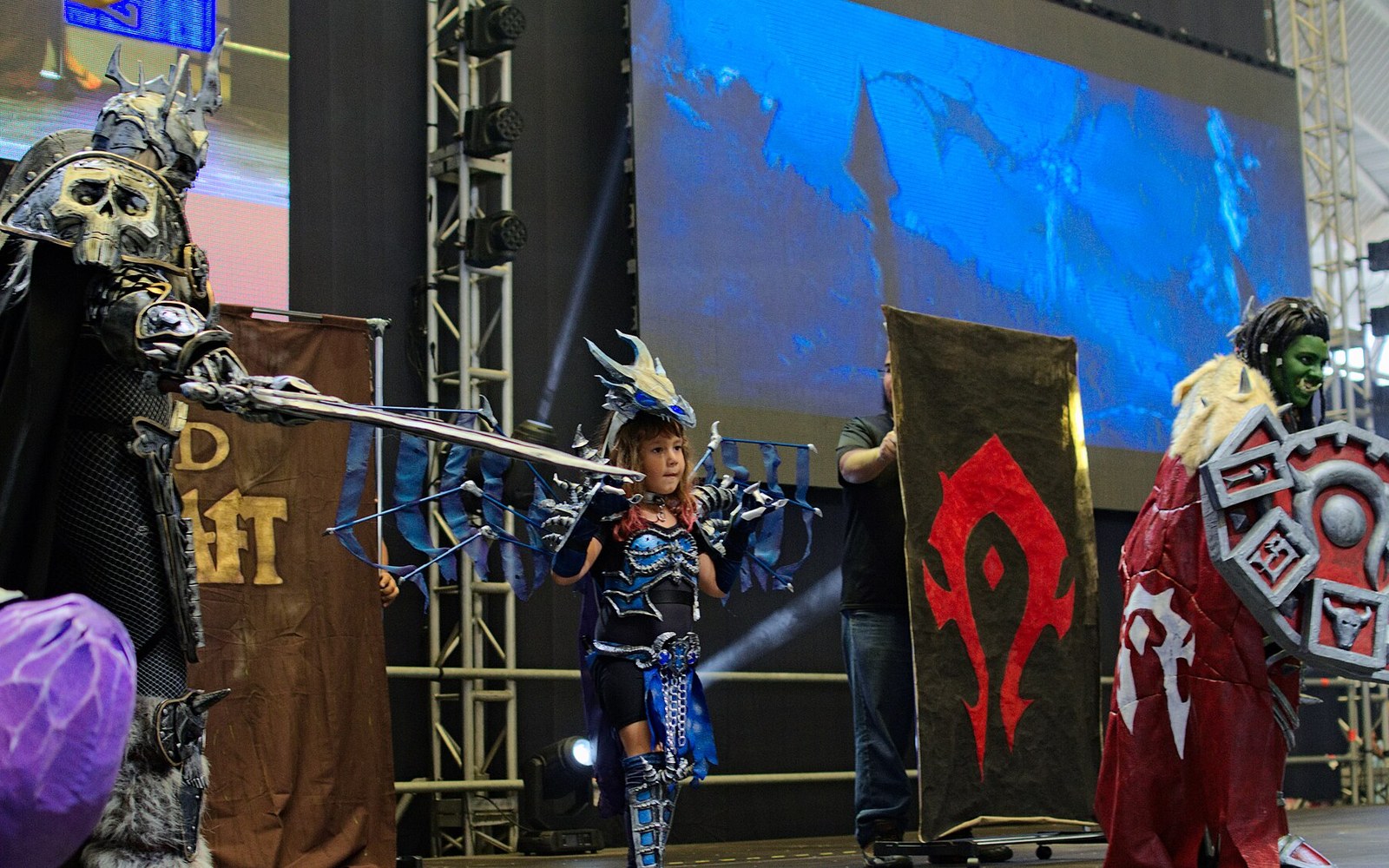
A sanctioned currency bridge turns gold into game time, and a floating price into a signal.
Photo: Group of Warcraft characters in TLP 2017 23 · Wikimedia Commons
Two subscription games built official real-money-to-currency pipelines. The mechanics differ; the regulatory intent is the same.

Photo: Roblox Logo 2022 · Wikimedia Commons
Sanctioned Pipelines, Different Architectures
Blizzard's WoW Token, introduced in April 2015, works as a two-sided market. A player buys a Token for real money from Blizzard's own shop, lists it on the in-game Auction House, and another player purchases it with gold — receiving either 30 days of game time or Battle.net balance. The gold price floats with demand; Blizzard sets the real-money price. The studio captures the retail transaction and eliminates the grey-market middle-man in a single mechanism.
Square Enix's approach through the Mog Station ↗ is structurally simpler. Chronoscrolls are purchased directly for real currency and grant 30 days of game time; a player who does not need the game time can sell the scroll to another player in-game for Final Fantasy XIV gil at a privately negotiated price. Unlike the Token, there is no exchange-rate float and no central marketplace — the transfer is peer-to-peer, and Square Enix's revenue event is already complete before the secondary exchange happens.
Both mechanisms share a common regulatory logic: by routing real-money-to-currency conversion through a licensed studio transaction, they position the exchange as a retail sale rather than gambling or unlicensed currency trading. The Belgian Gaming Commission's 2018 ruling ↗ on loot boxes, and parallel action by the Dutch Kansspelautoriteit, sharpened the industry's interest in mechanisms that carry predictable, fixed-value outcomes — a Token or a Chronoscroll delivers exactly what it says, which keeps it outside the chance-based definitions that drew regulatory fire. Neither product has been subject to a formal ruling, but both sit structurally at the opposite end of the spectrum from randomised reward systems.
What neither mechanism eliminates is the underlying real-money trading market — they compete with it by offering a sanctioned, lower-risk alternative.

The only public signal left on some of these games is a price or a count that moves; reading it means reading a screen like this one.
Photo: AlphaTradeZone / Pexels