Still Running — and How You Can Tell
Steam's Concurrent-Player Chart Is Public — Here Is What It Does and Does Not Prove
Explains SteamDB and Steam's own charts as a public dataset — how the figures are collected, what CCU actually measures, and where the methodology breaks down for MMOs that run their own launchers or split across regions. An explainer with named limits.
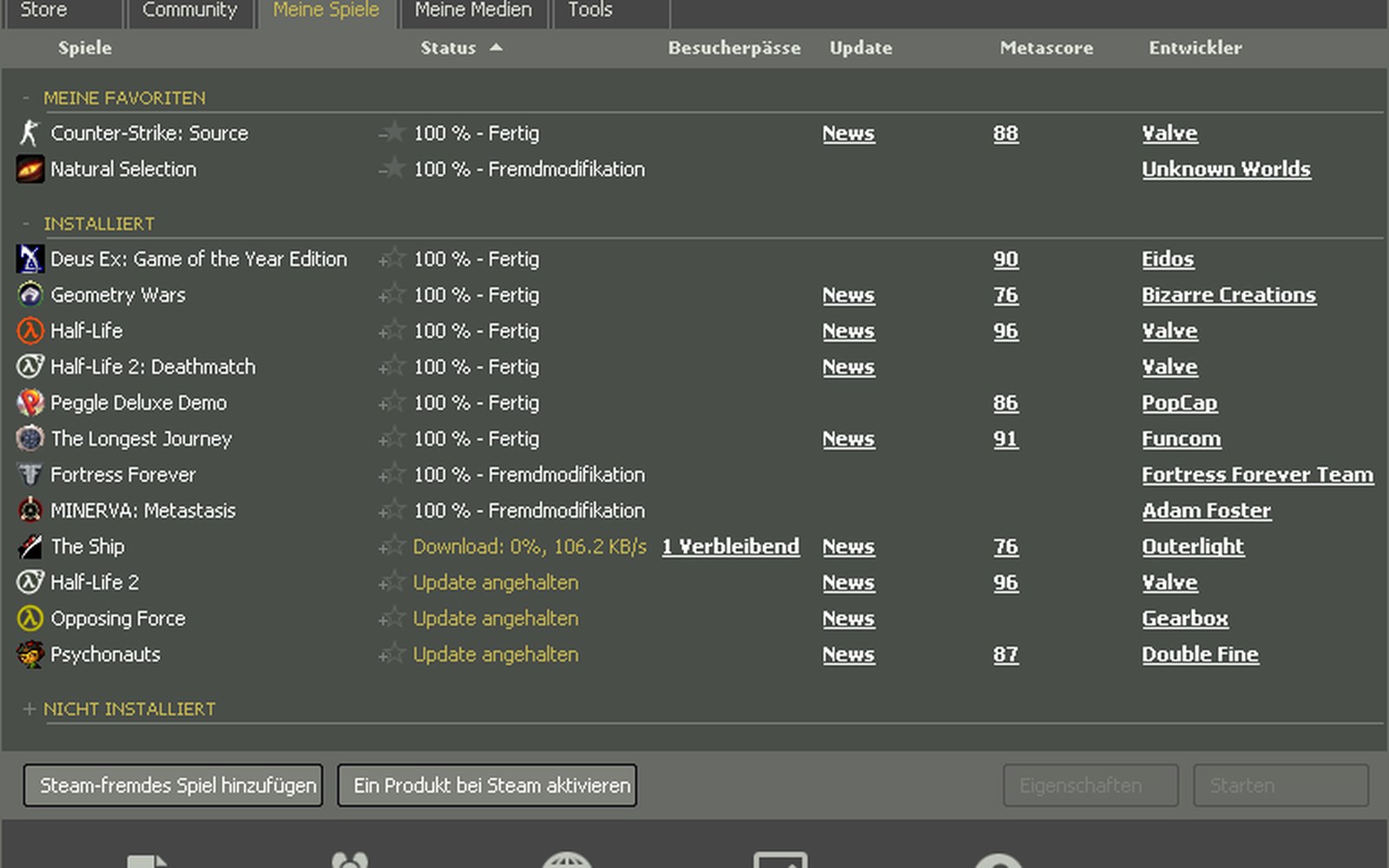
Valve publishes what is logged in through Valve. Everything with its own launcher is missing from the chart people quote.
Photo: STEAM haupt · Wikimedia Commons
SteamDB logs what Valve makes visible. What Valve makes visible is real, useful, and structurally incomplete.

The only public signal left on some of these games is a price or a count that moves; reading it means reading a screen like this one.
Photo: AlphaTradeZone / Pexels
The Data Is Genuine, and the Ceiling Is Baked In
When a game's Steam concurrent-user count appears on SteamDB, it reflects real telemetry. Valve's Steam platform ↗ reports peak concurrent users for games distributed through its storefront, and SteamDB — a third-party aggregator — archives that data historically, giving analysts a timestamped record of CCU highs and lows that studios themselves rarely publish voluntarily. For a genre in which publishers routinely substitute registered-account totals for live-health figures, that record is genuinely useful.
The structural problem is the denominator. Steam CCU counts only players who launched a game through the Steam client on that platform. It says nothing about players on the game's own launcher, console ports, regional storefronts, or mobile versions. For a mainstream action game with no separate client, this gap barely matters. For MMOs, it can make the chart almost unreadable as a measure of actual population.
What CCU Measures and What It Misses
CCU — concurrent users, meaning the count of players logged in at the same moment — is the genre's most honest available proxy for live health, more telling than registered-account totals, which publishers use precisely because the number never decreases. SteamDB archives CCU figures by game and by date, enabling comparison across titles and across time. When New World's Steam CCU collapsed from a launch-window peak to a fraction of that figure within months, the trajectory was documented publicly and unavoidably. When Throne and Liberty posted a sharp launch spike followed by a steep decline, the same chart showed it.

The segment table is where a mobile MMO states its revenue. Press coverage usually quotes the summary line instead.
Photo: Kindel Media / Pexels
What neither chart shows: the players who never touched the Steam version. Final Fantasy XIV is the clearest case. The game runs primarily through the Square Enix launcher, and its Steam edition represents only a portion of the global population. Square Enix has cited thirty million registered accounts ↗ as of 2023, a figure that dwarfs anything Steam CCU could capture for the title. Attempting to read FFXIV's health from its Steam chart alone would be methodologically indefensible.
The same limitation applies, with even greater force, to games with substantial Korean or Chinese player bases. NCSoft's Lineage series — a franchise whose mobile entries have outperformed most Western MMOs on revenue filings — runs through regional launchers entirely outside Steam's visibility. Nexon and Netmarble titles follow the same pattern. Pearl Abyss distributes Black Desert through its own client. CCP Games long distributed EVE Online the same way before adding a Steam presence. In each case, Steam CCU captures a slice, and the slice varies by title from modest to near-total.
The Methodology Behind the Number
SteamDB does not scrape private data; it reads what Valve publishes through publicly accessible endpoints, then preserves it longitudinally. The peak concurrent user figure — PCU, the highest CCU ever recorded for a given game — becomes a benchmark against which later figures are compared. That comparison is legitimate when the game in question is predominantly Steam-distributed and has not substantially changed its launcher strategy. It is unreliable when a studio migrates players between clients, adds a standalone launcher mid-cycle, or launches a console version that draws population away from the PC client without the Steam figure moving at all.
Sharding and megaserver architecture add another wrinkle. A game can sustain a stable or growing real population while its Steam CCU appears flat or declining, simply because new players are arriving through a different channel or because the architecture makes the game functional at lower per-instance numbers than earlier MMOs required.
What the Chart Actually Proves
Used carefully, the Steam concurrent-player chart proves one thing well: the relative trajectory of a game's Steam-client population over time. A sustained upward trend on a title with no significant off-Steam population is meaningful. A vertical post-launch drop is meaningful regardless of platform distribution, because it captures the cohort who tried the game and left. What it cannot prove is total population, regional health, or revenue — for that, the relevant sources are quarterly financial filings from named studios and commissioned estimates from firms like Newzoo and Sensor Tower, both of which operate with their own methodological boundaries. The chart is a signal, not a census.